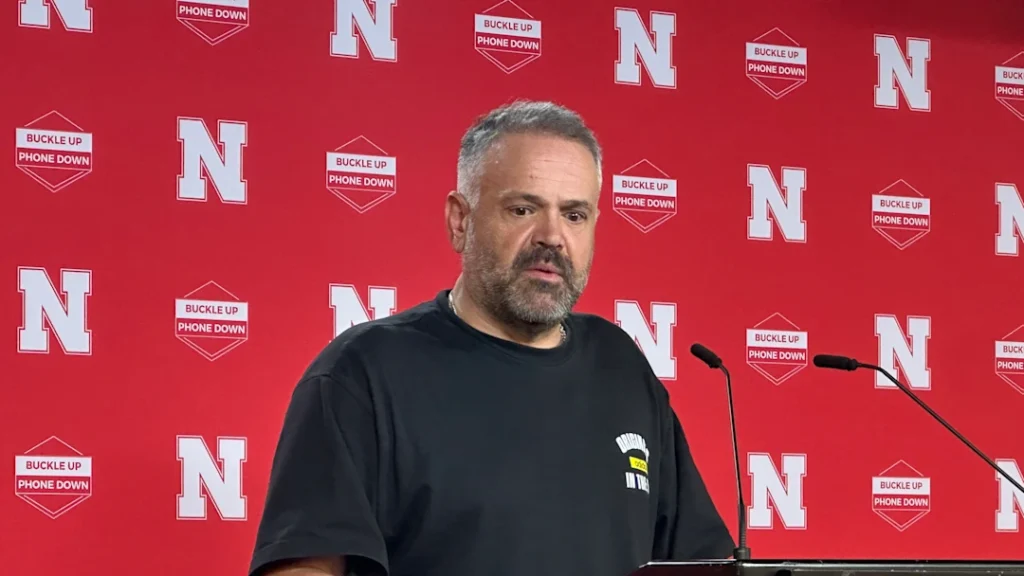
«Change before you have to.» This famous quote by Jack Welch seems to be the new mission statement in Lincoln. While Memorial Stadium awaits a $600 million renovation, Matt Rhule has decided his on-field rebuild can’t wait. Entering his fourth fall at the helm, the «Big Red Rebuild» has taken its most aggressive turn yet, sporting a roster and a coaching staff that is almost unrecognizable from a year ago.
Stability has been sacrificed for growth. To understand the scale of Rhule’s 2026 transformation, one only needs to look at the coaching staff: out of his original 2023 assistants, only two remain in their same roles—E.J. Barthel (RB) and Rob Dvoracek (LB). The rest of the «Big Red» engine has been completely swapped out in a desperate search for a winning formula.
Out with the 3-3-5, In with the Colandrea Era
The most jarring changes aren’t just in the offices but on the turf. The defense, now led by Rob Aurich, is scrapping the 3-3-5 scheme for a bulkier, more traditional 4-2-5 system. Aurich, who recently arrived from San Diego State, is focused on adding size to a front seven that struggled against the run in 2025.
However, the real earthquake occurred at the Quarterback position. After two years as the face of the program, former 5-star recruit Dylan Raiola has transferred to Oregon. In his wake, Nebraska has turned to Anthony Colandrea. The UNLV transfer brings a «dual-threat» dynamic that Offensive Coordinator Dana Holgorsen has been craving. Unlike his predecessor, Colandrea offers the mobility to extend plays, giving Holgorsen the versatile weapon needed to finally modernize the Husker offense.
A High-Stakes Gamble for Rhule
With only six assistants returning from last year’s staff, Rhule is sending a clear message: the past is irrelevant. The return of Phil Snow as Associate Head Coach provides the veteran leadership needed to glue these new pieces together.
This fall isn’t just another season in Nebraska; it’s a total reboot. If Colandrea and Aurich’s new-look defense can click, the Huskers might finally return to national relevance. If not, the $600 million stadium upgrade might be the only thing Husker fans have to look forward to.